Understanding the Voltage Divider
A voltage divider is exactly as it sounds. A voltage that is divided across two resistances.
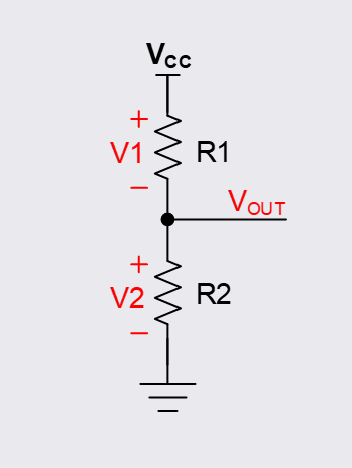
Click the image for a voltage divider calculator
To get the result of VOUT, we can use Ohm’s law and current “ICC” to solve. VCC is the voltage of the supply. ICC is the current out of the supply.
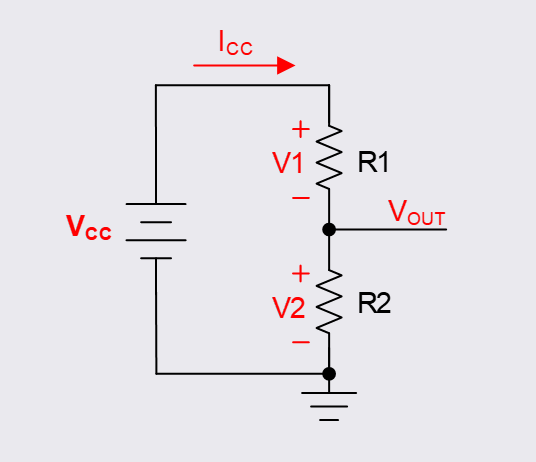
We can calculate ICC using Ohm’s law — V = I x R
Rearrange for “I”
I = V / R
Now calculate for ICC.
ICC = (VCC) / (R1+R2)
Now we must get an equation for the output voltage VOUT
VOUT = (ICC)(R2)
We can plug in our ICC equation to calculate VOUT as a function of voltage and resistance.
VOUT = (ICC)(R2) = [(VCC) / (R1+R2)] (R2)
VOUT = VCC (R2 / (R1+R2))
The output voltage is a ratio of the input voltage VCC.
If R1 is a very large resistance, i.e. a weak pull-up resistor, VOUT nears 0 V
If R1 is a very small resistance, i.e. a strong resistor pull-up resistor, VOUT nears VCC
If R2 is a very large resistance, i.e. a weak pull-down resistor, VOUT nears VCC
If R2 is a very small resistance, i.e. a strong pull-down resistor, VOUT nears 0 V
You can think of a resistive dividers output voltage as being pulled more towards VCC or more towards GND. This depends on which resistor (R1 or R2) is stronger.
For example, if VCC = 5 V, R1 = 10kΩ, and R2 = 100kΩ, you can estimate that the output voltage will be closer to 5 V than GND since there exists a stronger pull-up resistor to VCC.
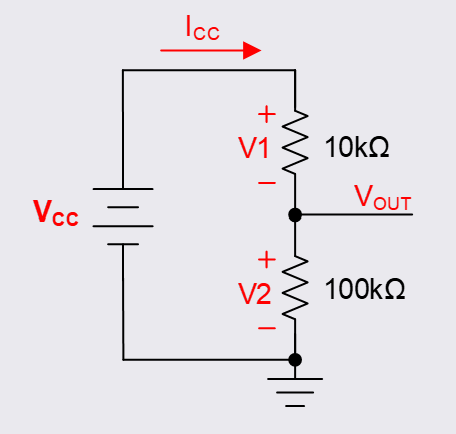
Using the DigiKey Voltage Divider Calculator, VOUT = 4.545 V
This makes sense because a 10kΩ resistor is much stronger to 5V than a 100kΩ resistor pulling to GND.
Here is a more severe example of a very strong pull-down resistor. What happens to the output voltage when VCC = 5V, R1 = 10kΩ, and R2 = 1Ω.
We can assume that since R2 is nearly a direct short to GND, that the output voltage will be near GND. Plugging the values into the calculator, VOUT = 0.0005 V or 0.5 mV. There is still a small voltage drop across a 1Ω resistor, but hopefully this drives the point home.
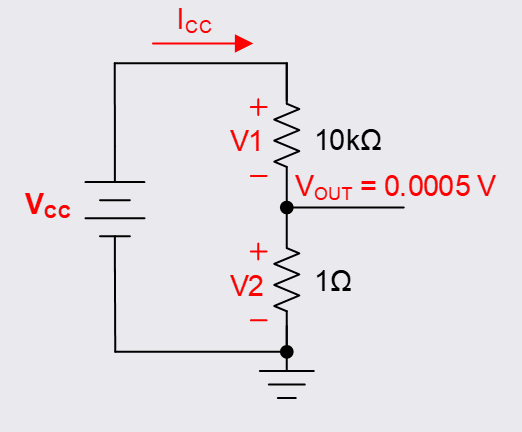
A strong pull-down resistor of 1Ω yields an output voltage of 0.0005V. This makes sense because a 1Ω resistor is practically a short to GND! The output voltage should be very near GND.
